New Delhi: India’s second Indigenous Aircraft Carrier (IAC-2) is shaping up to cost somewhere between $300 million and $500 million more than its predecessor, INS Vikrant — and the reason largely comes down to drones.
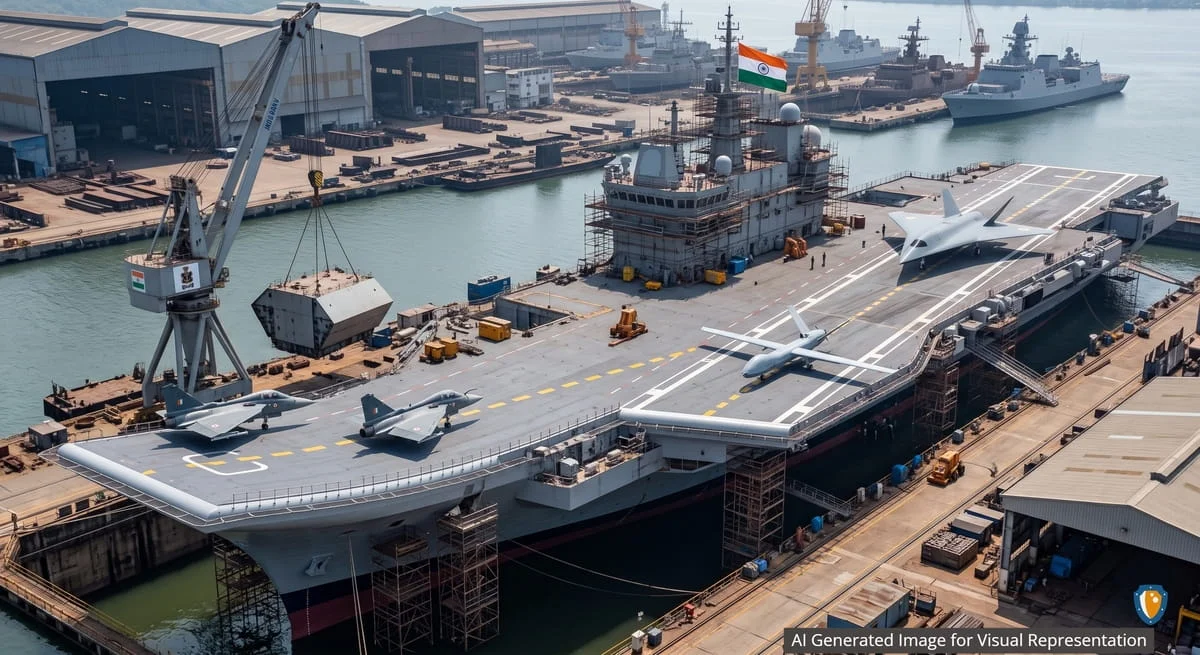
Sources familiar with the project say the additional funding is earmarked for design changes that will let the new carrier launch and recover unmanned aircraft, including Medium and High Altitude Long Endurance (MALE and HALE) drones as well as deck-based combat drones. The figures are still preliminary, and the project is waiting on final sign-off from the Cabinet Committee on Security.

What INS Vikrant Cost — and Why It Took So Long
INS Vikrant, the first ship in the class (IAC-1), was built by Cochin Shipyard Limited at a cost of roughly ₹20,000–23,000 crore, or about $2.5–2.7 billion — a figure that covered the ship’s construction but not its weapons systems or the fighter jets it carries. The carrier was ordered back in 2004, had its keel laid in 2009, and wasn’t commissioned until September 2022 — a 13-year journey that reflected just how much India’s shipbuilding industry had to learn along the way, from producing warship-grade steel to building complex aviation facilities and integrating all the ship’s systems more or less from scratch.
A “Repeat Order” to Save Time and Money
Rather than starting from scratch on a bigger, all-new supercarrier, the Navy is taking a repeat-order approach for IAC-2, sticking closely to Vikrant’s 45,000-tonne design. It’s a pragmatic call that limits both financial and scheduling risk while still moving the Navy toward its long-term goal of a three-carrier fleet. Cochin Shipyard has indicated that reusing the existing design, supply chains, and know-how built up during IAC-1’s construction could shrink the build timeline dramatically — down to somewhere between seven and nine years.
Built for a Different Kind of Air Wing
The biggest change from Vikrant will be in the air wing. Naval officials say the flight deck and internal facilities are being reworked to accommodate next-generation unmanned aircraft — including deck-launched unmanned combat aerial vehicles derived from programs like DRDO’s Ghatak project, along with HALE drones capable of far longer-range maritime surveillance than the helicopters currently used for early warning. That would make IAC-2’s air wing one of the first to combine piloted fighters with autonomous reconnaissance and strike aircraft operating side by side — part of a broader shift in the Navy’s thinking toward manned-unmanned teaming.

The Cost, in Perspective
Even with these ambitious upgrades, the overall cost increase is being kept fairly modest. Pushing the total to around $3 billion works out to roughly a 20% premium over Vikrant’s higher-end price tag — money that mostly accounts for inflation, rising material costs, and the modifications needed to the flight deck, hangars, and command systems to support mixed crewed and uncrewed operations. The main reason the cost hasn’t ballooned further is that reusing the Vikrant-class hull sidesteps the lengthy, expensive R&D phase that stretched out the first carrier’s timeline.
The Navy is aiming to get formal government approval for IAC-2 sometime in 2026. The Defence Procurement Board has already looked at an earlier, baseline version of the proposal — pegged at around ₹40,000 crore — before the drone-related changes were folded in.
If things go according to plan, India could end up building its second homegrown carrier roughly a decade faster than it built its first — while also taking its first serious step toward weaving drone warfare into carrier strike group operations. That, in turn, is expected to lay some of the groundwork for the much larger 65,000-tonne IAC-3 supercarrier concept, which remains under long-term study for now.